• Story
  • Cold Case Procedural
  • Two Timelines
  • Consequence Loop

Dead Channel

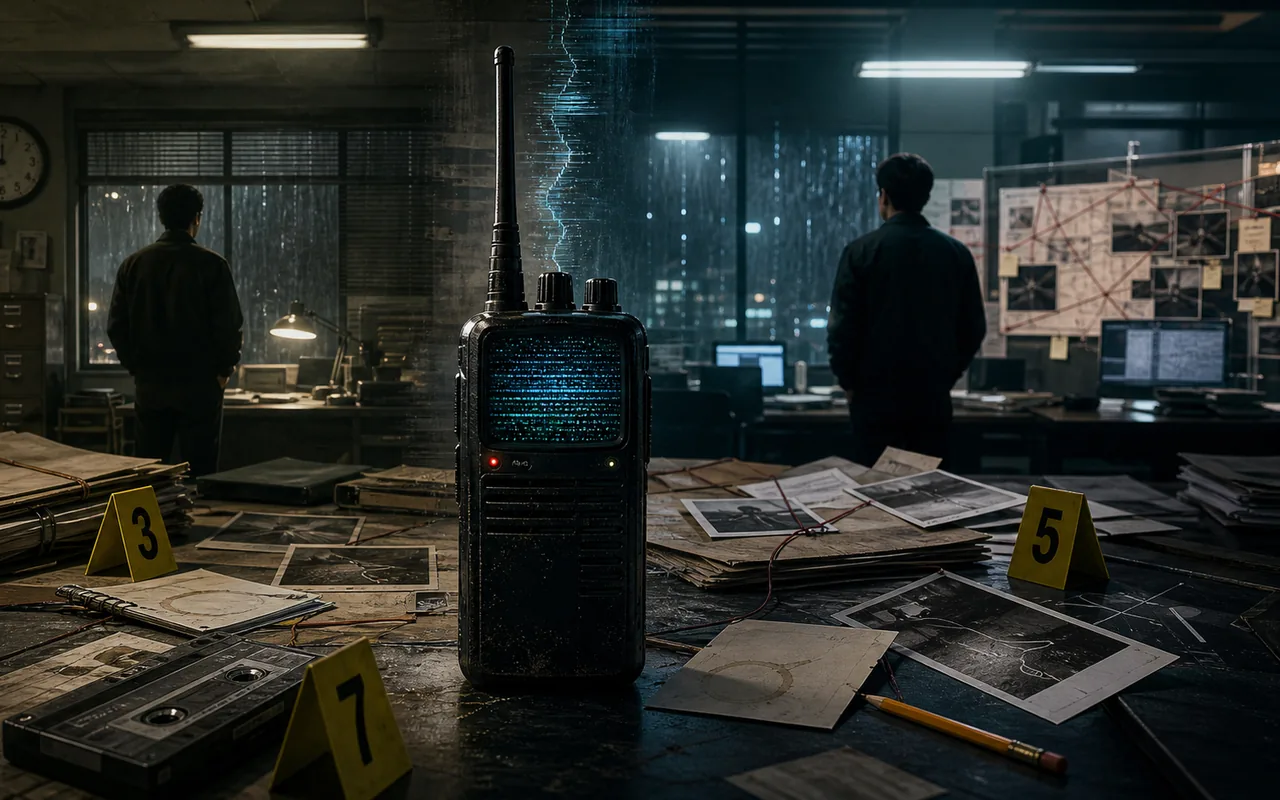
A scorched radio with no battery in it opens at 23:23. The man on the other end is calling from February 1999, and he needs a name.

Rennick, an American river city, tonight. You are the civilian clerk of a cold case unit that gets folded in forty-one days, boxing four thousand files in a sub-basement everybody calls the Well. Property item 4471 is a handheld radio, scorched down one side, pulled from a house fire in 1999 and never claimed. No battery in it. At 23:23 it opens for under a minute onto one channel, and on the other end a detective named Ray Tobin is working nights in February 1999, and he wants a name run. Only words cross. You have twenty-seven years of answers; he has a badge and one shift. What he does at his end lands here on the page while you are still holding the radio: a new headline on old microfilm, a name gone off a list, somebody alive who wasn't. Every rewrite is billed to your today, and you are the only one in Rennick who remembers the version before. There is no ending — the closer he gets to living through March, the weaker the channel gets.

PlayAI credits

How to play

  1. You open at 11:20 on a Tuesday night in the sub-basement, boxing files, with a scorched radio in your hand that has no battery in it — and at 11:23 a man comes on the air wanting a name run before his ninety seconds are up. Your first move is whatever you type back.
  2. After that you write freely every turn: a line you say into the radio, something you do in the archive or out in the city, or a whole paragraph of your own narration — and three suggestions sit under each turn for when you would rather not start from nothing.
  3. When a scene has gone as far as it can, hit Advance the story and it jumps forward; chapters close and file themselves as you go, and the next one opens on a Rennick that changed while you were deciding, and on a man whose week ran forward without you.

What makes it different

You never touch 1999 yourself. You have twenty-seven years of answers and no way to use one of them; he has a badge, a car and one shift. Everything you get, you get by telling a stranger something true and watching him decide what to do with it — and he is allowed to be wrong, to be scared, and to stop taking your calls.

Rewrites get billed. When the past moves, today moves on the page while you are still holding the radio, and something you were using is quietly gone: a job, a keycard, a person who used to answer that phone. Nobody else notices, because for everyone else it has always been this way. Only what is inside the room with you at 23:23 keeps the old version — which is why you write everything down.

Frequently asked questions

Do I need to pay to play Dead Channel?
You get 100 free credits when you sign up, and credits never expire. The game spends credits only when it generates new AI content, based on actual usage — there's no fixed per-round fee and no subscription required to start.
What kind of game is this?
An open-ended novel you write with an AI. You play a records clerk in an American river city, you type in your own words, and the AI writes Rennick back at you in real time — no multiple-choice options, no dice, no stats.
What can I type?
Anything: a line into the radio, an action, or a whole paragraph of prose. Each message has two destinations — Continue story puts it into the book as written, while Direct the AI passes a private note to the storyteller about where you want this to go. There are also three suggested openings under every turn if you would rather pick than write.
Does the story ever end? How long can I play?
There is no ending and no final confrontation. The man on the other end can never simply be saved, because the channel runs on what happens to him. Chapters fill up, close and file themselves, and the next one opens on a city that kept moving — so it runs as long as you keep writing, and you can leave it for weeks and pick it up where you left off.
Do I need other players?
No. It is single-player; the AI plays everyone else, including the voice on the other end of the channel.
Is anything I write kept?
Yes. The story saves as it goes and archives chapter by chapter, so you can open the directory and reread any of it. Inside the fiction it matters too: what you wrote down is the only version that survives a rewrite, and it is the one thing nobody can take off the page.
Is there a Chinese version?
Yes — Simplified Chinese and English, each written for its own readers rather than translated line for line.